Production Counts
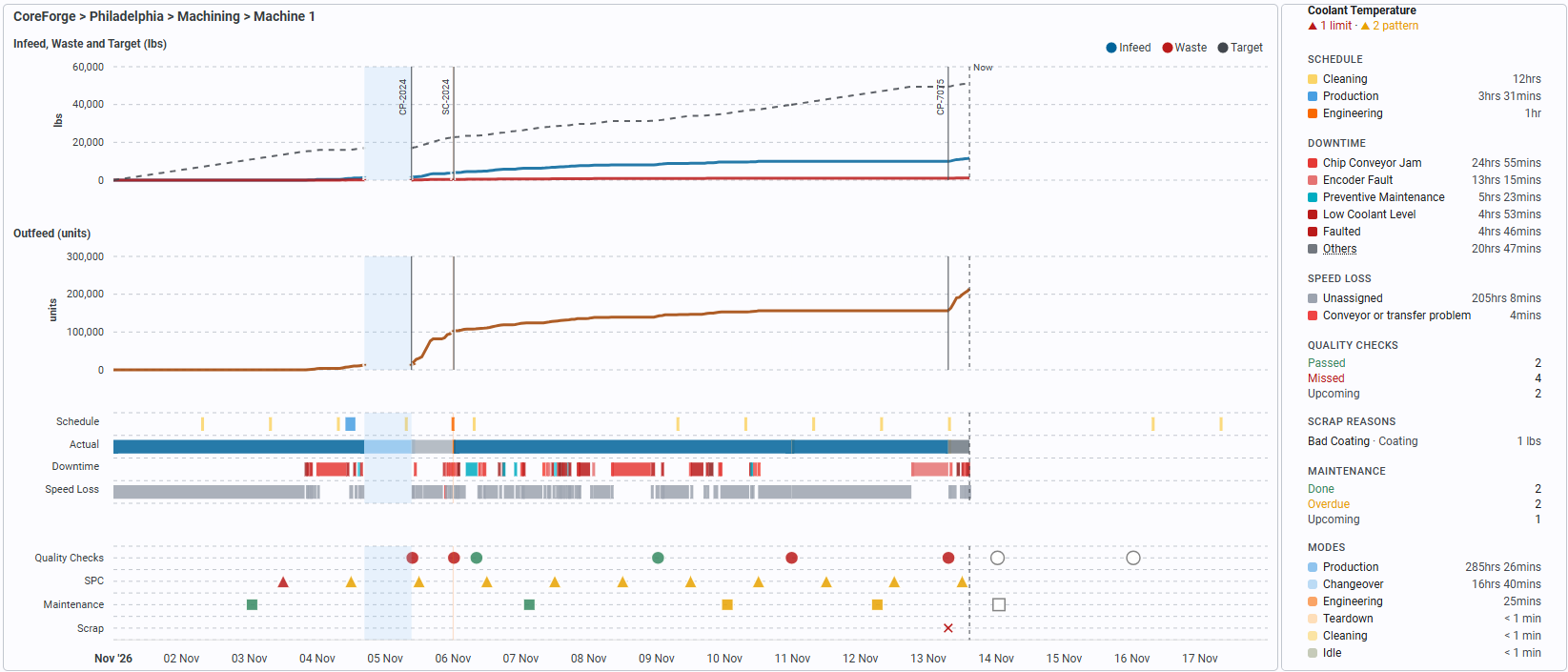
The Production Counts chart shows how an asset's infeed, outfeed and waste built up over a date range against its target, with the modes and items it ran along the way, what was scheduled against what actually ran, and the downtime, slow running, scrap, quality checks and maintenance that went with it.
Choosing what to chart
Select an OEE-enabled asset and a date range, then click Go. The chart shows one asset at a time. Selecting a site or an area instead shows the assets under it as cards; click a card to move down the tree, and selecting an OEE-enabled asset loads its chart.
The chart covers up to 7 days. A longer range (a Custom one, or the dashboard's date range for the Production Counts widget) shows Choose a range of up to 7 days instead of a chart, as reading weeks of events and counts at once slows the gateway and the browser. Year To Date, This Month, Last Month and Last 14 Days are turned off in the date selector, and the arrows beside it move the range a week at a time (the period list beside them still offers day, month and year steps).
While the date range includes now (for example, Today or This Week), the charts keep themselves up to date: the counts, modes, downtime, speed loss and scrap refresh every minute, and the SPC alerts, tooling, quality checks, maintenance and schedule every 10 minutes. A range entirely in the past doesn't refresh.
Updated at the top of the totals panel shows when the chart last read its data, in your device's time zone. Its icon and time turn green for a few seconds each time the chart refreshes.
Reading the chart
Each line is a running total, so it rises as the asset produces and stays flat while it doesn't:
- Infeed, Outfeed and Waste are the counts recorded while the asset was in a Production mode. Counts made in any other mode (Changeover, Idle, Maintenance and so on) aren't included, and the lines break while the asset isn't in Production.
- Target (dashed) is the standard rate of the item running, times the production time. Its slope changes when an item with a different standard rate starts, so the gap between Outfeed and Target shows how far ahead of or behind target the asset is at any point in the range.
The lines follow the counts hour by hour, whatever interval the table uses. A count with nothing recorded in the range isn't drawn, and its total is left out of the panel.
Hovering over the chart shows every line's total at that time, with its units, and what the asset was doing under the mouse: the mode with when it started, when it ended and how long it lasted, or for Production, the item, the work order and its required quantity.
When the counts are in different units (for example, infeed and waste in lbs and outfeed in units), the chart is split into two plots stacked on the same time axis, each titled with what it shows. When all the counts are in the same units, there's a single plot.
The chart runs to the end of the date range. When the range ends after now (for example, This Week), the lines stop at a dashed Now line, and the space after it shows the quality checks and maintenance scheduled for the rest of the range.
Zooming in
Drag across the chart to look at that time more closely: the date selector switches to Custom with the dragged range, and the chart, timeline, events and totals reload for it. A Zoom out icon appears beside the period arrows; each click goes back one step, to the range before the last drag. Picking a range in the date selector clears the zoom steps.
Modes
The time the asset spent in a mode other than Production is shaded on the chart in that mode's colour. Production isn't shaded; the Actual row of the timeline shows each Production run in its item's colour.
Items
A vertical line marks each point where the item changed, labelled with the item that started (some labels are left off when changes are close together).
Tooling
On an asset that uses tooling, a coloured diamond along the top of the chart marks each point where a different tool (a mold, die and so on) was mounted. Each tool keeps one colour, matching the Tooling list in the totals panel. Hover over a diamond to see the tool, when it was mounted and how long it stayed on. Taking a tool off and putting it back on isn't marked as a change, and a tool mounted inside another tool (an insert in a mold base) isn't shown separately.
SPC alerts
When the asset has measures with SPC checking turned on, a triangle on the SPC row under the timeline marks each interval with an SPC alert: red when a measure went beyond a control or specification limit, amber for a pattern (a run or trend that shows a shift or drift), and grey for too little variation. Hover over a triangle to see the measures and the rules they broke.
The alerts are worked out for the date range with each measure's current limits, using the same rules as the measure's live SPC check. Past alerts aren't stored, so if a measure's limits changed during the range, its earlier values are judged against the new ones.
Timeline
Under the counts, a timeline shows on the same time axis, row by row:
- Schedule: the operations scheduled for the asset, in each one's mode colour.
- Actual: what the asset actually did, a bar for each run in every mode. Production runs are in the item's colour, other modes in the mode's colour, so the Schedule and Actual rows can be compared directly.
- Downtime: each downtime event, in its state's colour.
- Speed Loss: each period the asset ran slower than its standard rate (a performance event), in its reason's colour. Automatic speed-loss events show as Unassigned until an operator gives them a reason.
A row with nothing in the range is left out, and the timeline is only as tall as the rows it shows. Very short events are drawn a little wider so they can be seen. Hover over a bar to see its details: the item, work order and required quantity of a run, the state and note of a downtime, or the reason, times and minutes lost of a speed loss.
Quality checks, SPC, maintenance and scrap
Below the timeline, the asset's quality checks, SPC alerts, maintenance work orders and scrap are marked on the same time axis:
- Quality Checks (circles): the check sheets scheduled in the range, at the time each was taken (or due, if it wasn't).
- SPC (triangles): the SPC alerts described above.
- Maintenance (squares): the maintenance work orders due in the range, on the asset or on a tool mounted on it.
- Scrap (red crosses and amber diamonds): the waste recorded with a reason (coded scrap), and the hours with a lot of waste recorded without one (uncoded scrap). See Scrap markers below.
Quality and maintenance marks are coloured by status: green for a check passed or a work order done, red for a check failed or missed, amber for overdue, blue for a work order in progress, and an empty grey mark for one still to come. Hover over a mark to see the check sheet or the work order. As on the timeline, a row with nothing in the range is left out, and the plot is left out when the asset has none of these in the range.
Scrap markers
The Scrap row shows two kinds of marker:
| Marker | Meaning |
|---|---|
| Red cross (✕) | Coded scrap: waste counted with a reason (an item state), at the time it was counted. |
| Hollow amber diamond (◇) | Uncoded scrap: an hour in which the waste counted without a reason reached the threshold (5% of the hour's infeed by default). |
Coded scrap. Each waste count with a reason gets a cross at the time it was counted. Hover over it to see the reason, its category, the quantity, the item, the work order and the time. Counts that are close together (within 1% of the chart's date range, about a marker's width) are merged into one cross, so several reasons recorded at the same time don't hide each other. The hover of a merged cross lists each reason with its category and quantity, most first, under the number of reasons and their total, for example 3 scrap reasons, 150 units, and the time (or times) they were counted.
Uncoded scrap. Waste that's counted without a reason is on the Waste line but has no count of its own to mark, so the chart works it out by hour:
- It takes the hour's waste (the same counts the Waste line uses) and subtracts the coded scrap counted in that hour. What's left is the hour's uncoded waste.
- It compares the uncoded waste with the hour's infeed. When it's at least the threshold percentage (5% by default), the hour gets a diamond at its start.
Hover over a diamond to see the uncoded waste, its percentage of the infeed with the threshold it was checked against, and the hour, for example Uncoded waste: 2,000 units, 10% of infeed (marked from 5%), Nov 10, 22:00 to 23:00. Diamonds that are close together are merged in the same way as crosses: the hover gives the number of hours and their total (Uncoded waste in 2 hours, 55.4 lbs), then each hour on its own line.
Some details of how the diamonds are decided:
- Units. The waste is compared with the infeed when both are counted in the same units. When the waste is in the outfeed's units instead (for example, infeed in lbs, outfeed and waste in units), it's compared with the outfeed. When neither matches, a percentage can't be worked out, so every hour with any uncoded waste gets a diamond, and its hover says what units the waste, infeed and outfeed are in.
- No infeed. An hour with uncoded waste but no infeed (or outfeed) counted is marked, and its hover says so.
When a cross and a diamond touch, the hover of each also shows the other's text, so whichever one is under the pointer shows both.
The times in the scrap hovers are in your device's time zone, the same as the chart's time axis.
Totals
The panel on the right of the chart shows the date range's totals, under Updated (when the data was last read) and the export and table buttons. Most sections open somewhere to act on them when clicked, for a user who is logged in with the right to do so: the section darkens under the pointer, and its tooltip says what it opens.
- Runs: each run in Production over the range is a section of its own, in order: its work order and item (just the item when it has no work order), how long it ran in Production, and its start and end in the range. Hover over a run to see its Target, Infeed, Outfeed and Waste with their units, its Target Rate and its Actual Rate (its infeed over its run time), and to shade its time on the chart. Click a run to open the count editor for it. A run that started before the range, or is still running, counts and opens from the start of the range or up to now, so the editor shows the same counts as the section.
- Tooling: each tool mounted on the asset over the range, in its diamond's colour, with how long it was mounted.
- SPC Alerts: for each measure with SPC checking on, its alerts by kind (limit, pattern, variation), or No alerts. Consecutive readings in violation count as one alert. Opens the Measure SPC Analysis.
- Schedule: the time scheduled in each mode.
- Downtime: the time in each downtime state, longest first. Past the top 5, the rest are grouped as Others; hover over Others to see them. Opens the downtime table.
- Speed Loss: the time lost to slow running by reason, most first, top 5 and Others in the same way. Opens the range's speed loss events, where a reason can be set.
- Quality Checks and Maintenance: how many checks and work orders the chart shows, by status. Each opens its list.
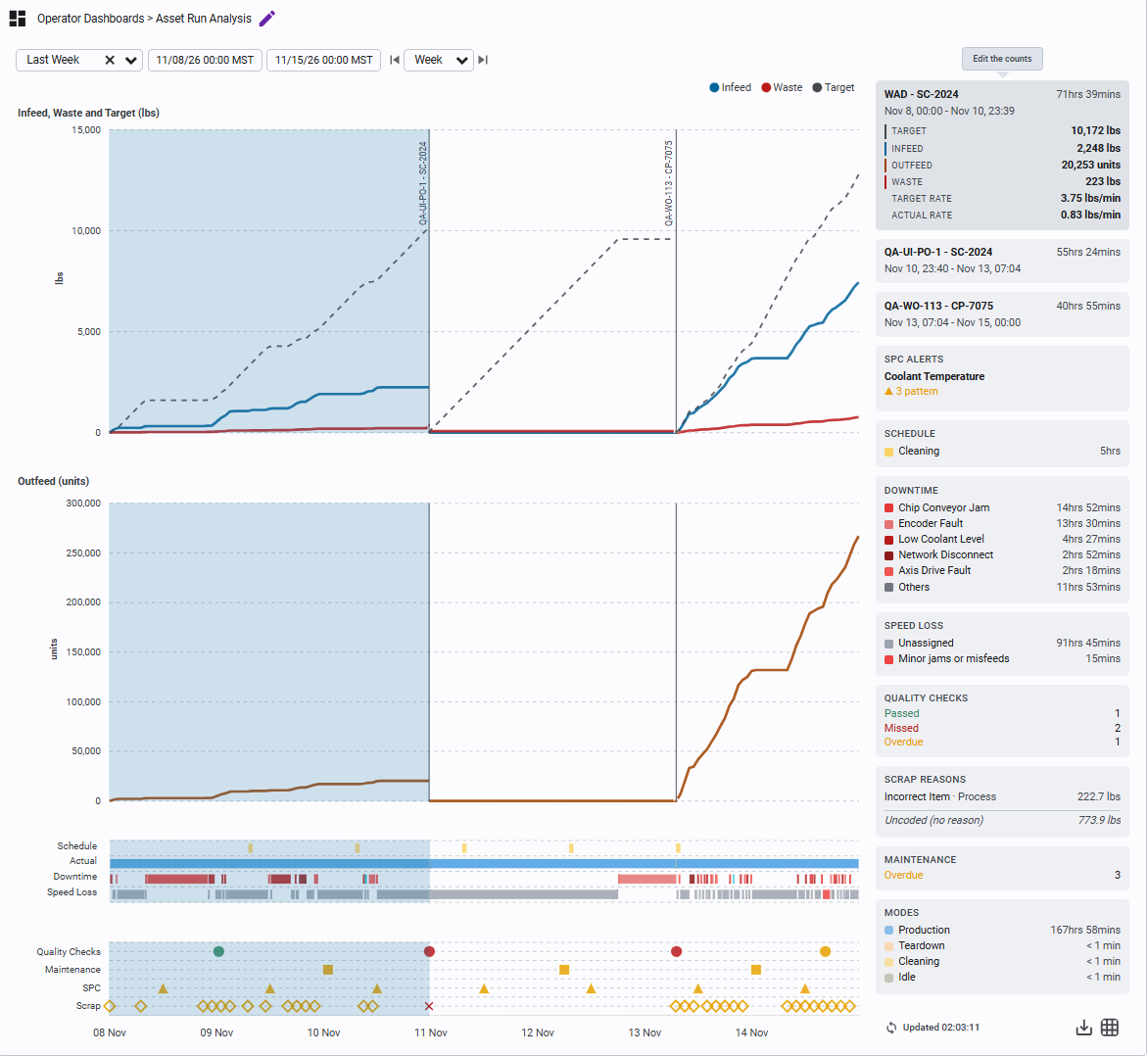
- Scrap Reasons: the waste recorded against each reason, most first, with its category. Under them, Uncoded (no reason) is the waste with no reason over the range, run by run: each run's waste less the coded scrap in it. Opens the Scrap editor.
- Modes: the time in each mode, Production included, longest first, in the colours used on the chart.
Coding scrap
Clicking Scrap Reasons opens the Scrap editor for the chart's asset and date range, to give waste a reason (code it), change or clear its reason, or delete a waste count that was wrong. It lists:
- The waste counts, grouped by Group by: 15 min (the default), Entry (each count on its own), Hour or Run. A group holds the counts with the same reason, item, work order and counter, so a group never spans two runs. Each row shows the group's time, its reason (or Uncoded), its quantity and how many counts it holds.
- Uncoded (calculated): a row for each run whose waste has no waste counts at all. Such a run's waste is calculated from its infeed and outfeed (infeed less outfeed times the package count), so there's no count to code until it's given a reason. It's one row for the whole run, while the chart's Scrap row marks the uncoded waste hour by hour; the editor says so when it shows one.
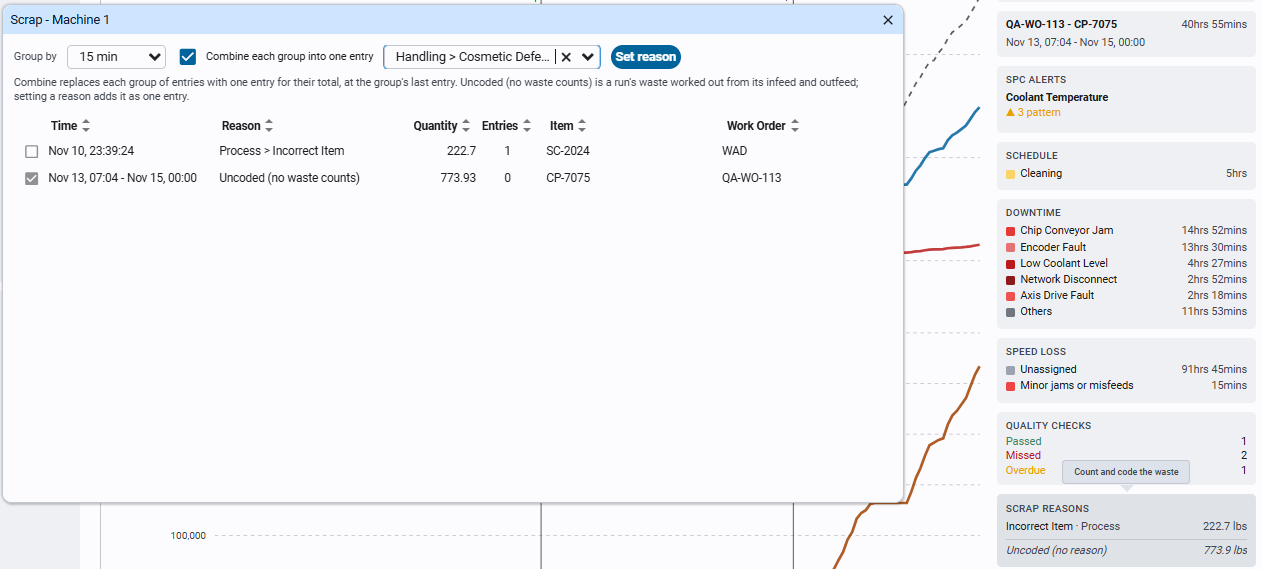
Click rows to select them, then:
- Set reason: gives the selected rows the reason picked in the list beside it. With Combine each group into one entry ticked (the default), each group's counts are replaced by one count for their total, at the time of the group's last count, with the same item and work order, which keeps the chart's lines where they were and leaves fewer counts to code next time. Unticked, each count keeps its own time and only its reason changes. An Uncoded (calculated) row is added as one count for the run's full waste, a second before the run's end, so the run's waste stays the same.
- Clear reason (shown once a waste count is selected): sets the selected counts back to uncoded, combined in the same way.
- Select uncoded (shown when there are two or more uncoded rows): selects them all, to code them with one reason.
- Delete (shown once a waste count is selected): removes the selected counts. The first click turns it into Confirm Delete; the second deletes. A run left with no waste counts has its waste worked out from its infeed and outfeed again.
With Group by set to Entry, a count's quantity can be changed in the table; it keeps its time. The chart, its totals and the runs refresh after each change.
Not logged in, the editor only shows the waste: it has no controls, checkboxes or buttons. A waste count can also be added from a run's count editor (click the run in the totals panel).
On the operator station: Asset Run Analysis
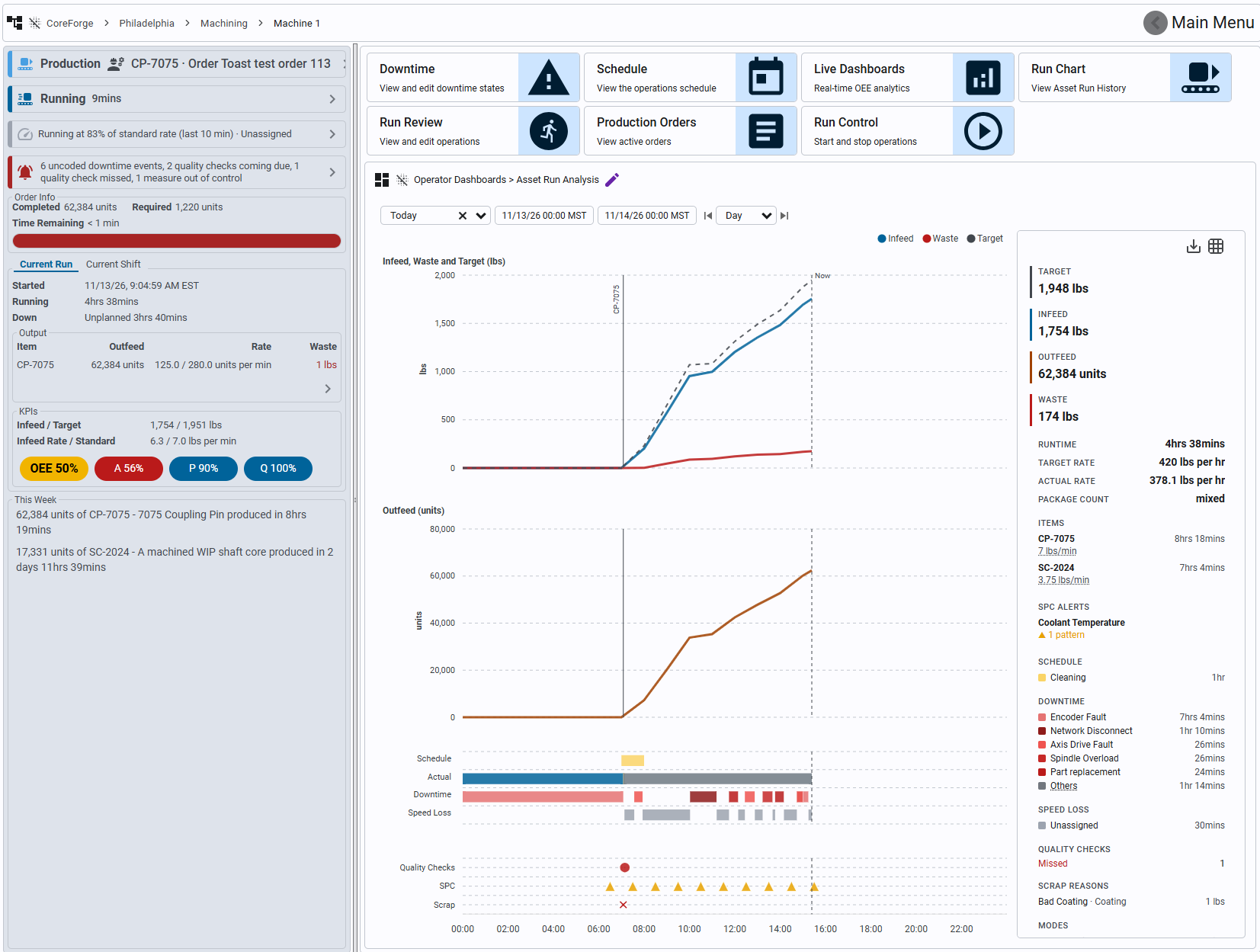
The Asset Run Analysis dashboard (in Operator Dashboards) shows the same chart for the operator station's asset, with a date range selector above it. A new installation uses it as the operator station dashboard for every asset, and a new OEE-enabled asset gets it as its own dashboard. An asset's dashboard can still be changed from the operator station.
Options
The chart is also the Production Counts dashboard widget, which has these settings:
- showDateRange (on by default): a date range selector above the chart. Turned off, the chart uses the dashboard's date range, or today when the dashboard has none.
- showOptions (off by default): a row of check boxes above the chart. Show Infeed, Show Outfeed, Show Waste and Show Target turn each line on or off (at least one stays on), and Show Modes turns the mode shading and the Modes list on or off.
- showAssetName (off by default): the asset's name above the chart.
- uncodedScrapPercent (5 by default): the threshold for the uncoded scrap diamonds, as a percentage of the hour's infeed (see
Scrap markers). Raise it to mark only the hours with the most uncoded waste, or set it to 0 to mark every hour
with any. Decimals such as
2.5work.
To change a setting, edit the dashboard and open the widget's Configure Widget settings (see Editing Dashboard Widgets). The Production page, and a dashboard widget saved without uncodedScrapPercent (such as the bundled Asset Run Analysis dashboard), use 5%.
The buttons at the top of the totals panel export the data, or switch between the chart and a table of the counts by interval. The table and the export group the counts by hour for a range of up to two days, and by day beyond that. The totals panel stays beside the table.