Assets
| In This Section | |
|---|---|
| Asset Model and ISA-95 | Understanding the asset model |
| Creating Assets | Create your asset model |
| Configuring Asset Tag Data Sources | Connect to your asset data source |
| Custom Attributes | Configure custom attributes for your assets |
| Asset States | Define and link states to your assets |
| Counters | Link counts with scrap reasons or first pass/rework metadata |
Watch Asset Configuration Tutorial
An asset is any entity that needs tracking or summarizing within the operational environment. Assets represent different physical or logical elements within a manufacturing setup and may refer to a specific machine, a manufacturing line, or an entire factory. Assets are organized in a hierarchical structure.
Asset Model and ISA-95
ISA-95 defines a rigid hierarchy for your plant equipment consisting of Enterprise > Site > Area > Line > Cell or Cell Group. You can follow ISA-95 as you build your asset hierarchy, or model your assets as they make sense for your organization. Models can be multi-enterprise, organized by region, division or department or however you want to. At a minimum, sites must exist somewhere in the hierarchy to associate time zone information to assets. After that it's up to you.
Creating Assets
Assets are configured by navigating to Configuration > Ops > Assets.
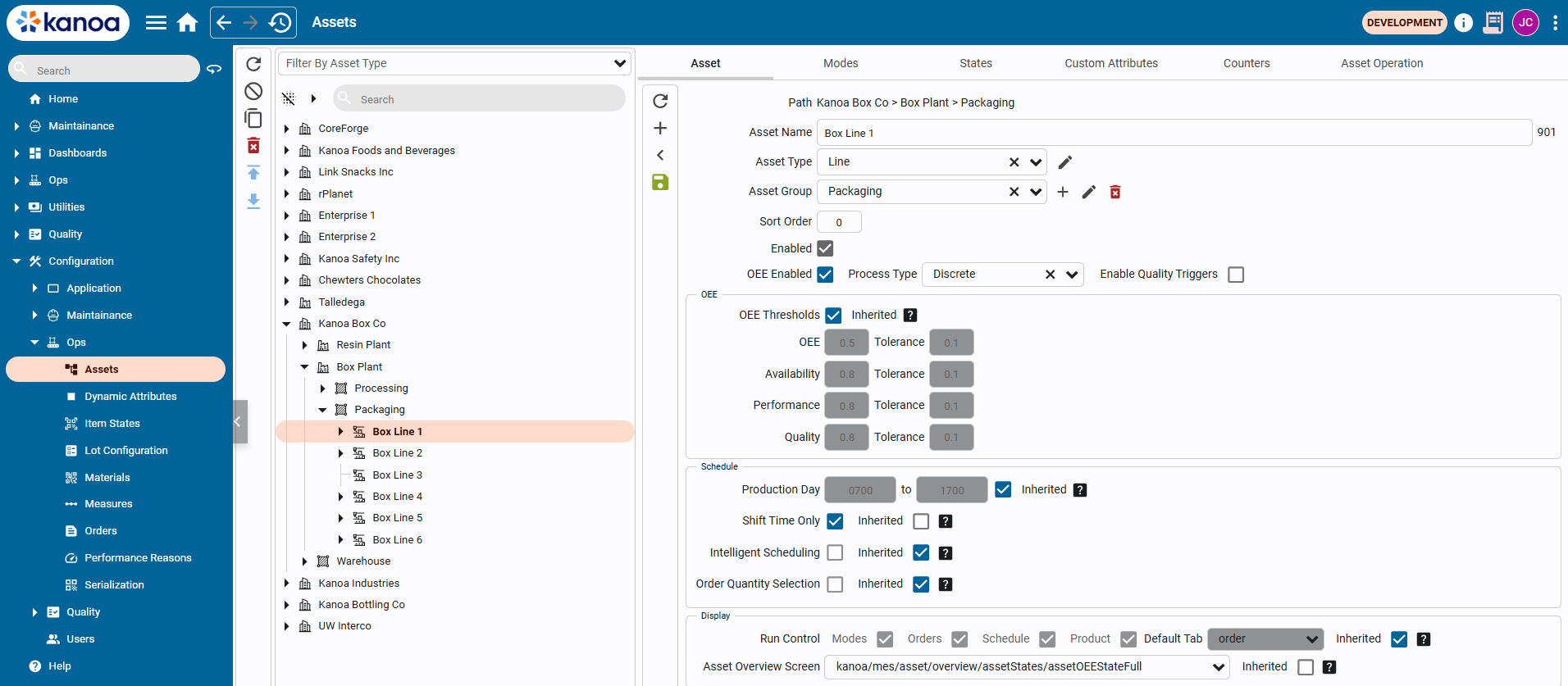
Once an asset has been created, it can be duplicated or exported. All configuration information such as mode links, state links, item links are duplicated / exported along with the asset. Exported assets can then be transferred between gateways such as from dev to prod.
| Field | Description |
|---|---|
| Asset Name | The name of the asset. Asset names must be unique within the parent. |
| Asset Type | Used for defining the type of an asset, akin to the ISA-95 hierarchy (e.g. enterprise, site, region). To configure asset types, use the edit button next to the right of the asset group dropdown. |
| Asset Group | An asset can be associated with a group such as 'shredders'. Grouping allows for analysis of assets that may not be in the same hierarchical area but need to be reported similarly. For instance, assets like 'box formers' across different lines can be grouped under a single asset group for consolidated reporting. To add an asset to a group, simply select the group from the dropdown. If the group doesn't exist, start typing the name of the group into the dropdown and select 'create'. |
| Sort Order | Determines the asset's position relative to others. |
| Enabled | Enable or disable this asset |
| OEE Enabled | One of the primary uses of an asset in Kanoa Ops is enabling it for OEE tracking. An OEE_Enabled Asset refers to any physical piece of equipment such as a production line, vessel reactor or process cell where operational data such as counts and equipment can be obtained and needs to be monitored. If an asset is OEE_Enabled, targets can be set for performance, availability, quality, and overall threshold that are used in visual indicators while an asset is in production. An instance of our assetOEE tag UDT is also created in the [Kanoa] tag provider that provides a mechanism for connecting the physical machine to our MES. See the [Configuring Tags] section below. |
| Process Type | When asset is 'OEE Enabled', asset process type can be configured as 'discrete, continuous or batch. Assets of type batch are configured differently for OEE performance calculation |
| Enable Quality Triggers | When asset is 'OEE Enabled', enabling this setting will cause changes to this asset mode or shift to check if a quality check should be scheduled. |